IT Operations context
- ITSM
- Ticketing
- Monitoring
- Incident management
- Service desk
- Asset management
IT
Production-grade AI agents for IT teams, built around your infrastructure, systems, workflows, and security standards to automate routine work, improve responsiveness, and expand capacity without adding headcount.
Secure · Production-grade · Human-controlled · Built inside your environment
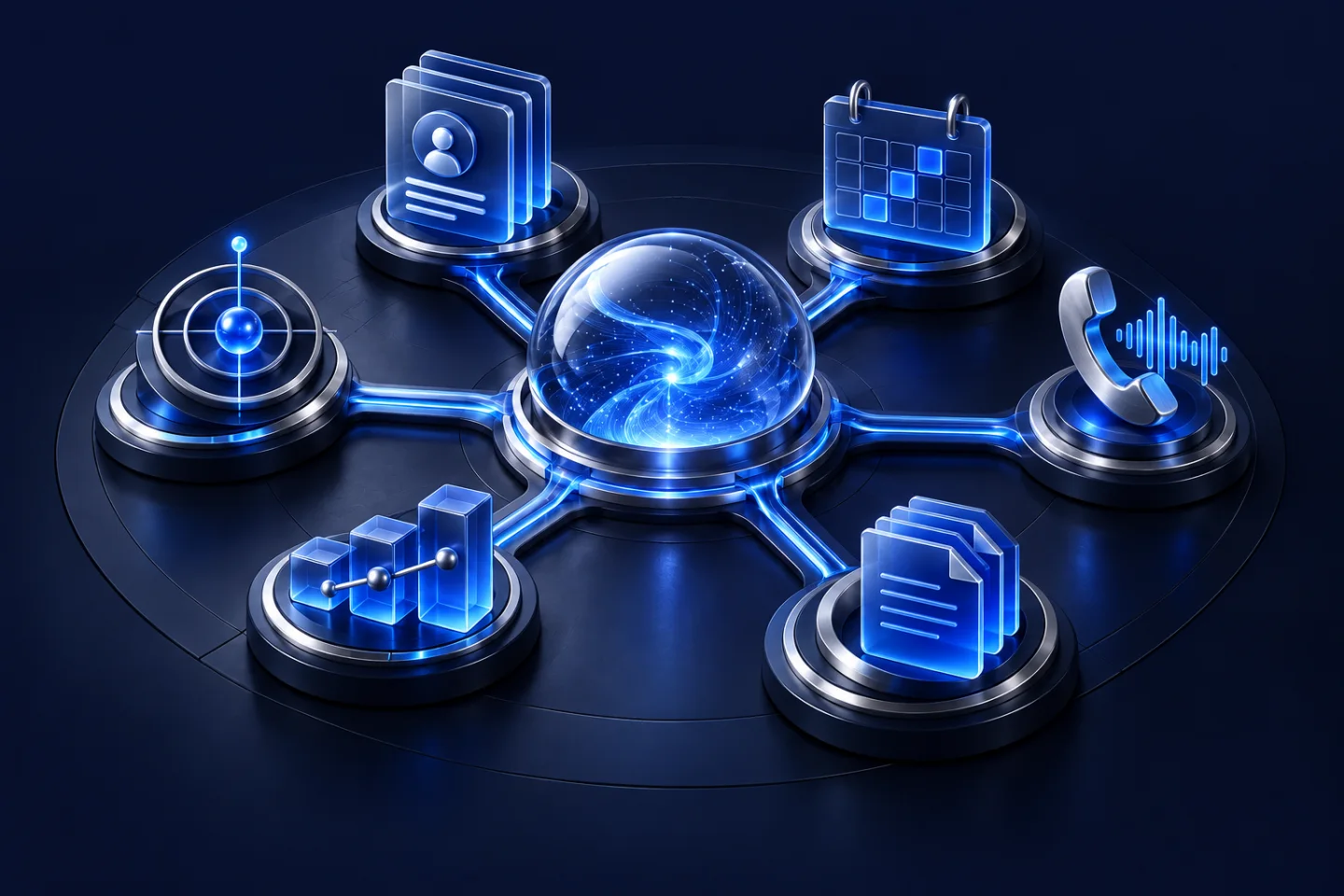
Shared context for every agent, system, and workflow.

Start With the Work That Consumes the Most Capacity
Classifies incidents, gathers context, and prioritizes the response.
Handles routine employee requests and gathers the information needed for more complex cases.
Analyzes logs, history, architecture, and related events to accelerate investigation.
Recommends or executes approved remediation steps.
Turns operational knowledge into repeatable guided or automated workflows.
Identifies inefficiencies, underused resources, recurring issues, and optimization opportunities.
Surfaces what changed, what matters, where risk is growing, and what leadership should focus on.
From Reactive IT to Agentic IT
Traditional IT teams spend too much time reacting: Tickets Incidents Manual investigations Routine requests System checks Escalations Documentation Repeated troubleshooting Agentic IT changes the operating model. AI agents can continuously monitor signals, gather context, execute approved actions, escalate exceptions, and learn from outcomes. Your team stays in control while more of the routine execution becomes automated.
IT 2.0
A practical 90-day transformation program designed for CIOs and IT leaders who want to move securely and measurably from traditional IT operations to an agentic model. The program combines three priorities:
Improve the foundations before adding more automation. Infrastructure Processes Data access Security Observability Governance
Deploy AI agents into high-value, repeatable IT workflows. Triage Investigation Resolution support Routine administration Knowledge retrieval Workflow execution
Use the capacity and savings created by automation to fund the next stage of transformation. Optimize → Save → Reinvest → Expand
Measurable Impact in 90 Days
The goal is not to run another AI pilot. It is to create measurable operational improvement within one quarter.
Reduce the time required to investigate, coordinate, and resolve recurring work.
Automate repetitive tasks and return capacity to the team.
Move from waiting for tickets to detecting issues and acting earlier.
Establish a governed foundation for AI agents across IT.
Enable the organization to support more systems, users, and complexity without growing the team at the same rate.
The IT operating layer
Specialized agents working from shared enterprise context.
Shared enterprise context
Representative examples we build for IT teams
Specialized agents working from shared enterprise context.
Monitors operational signals and identifies what needs attention.
Classifies incidents, gathers context, and prioritizes responses.
Analyzes operational evidence to accelerate investigation.
Recommends or executes approved remediation steps.
Handles routine employee requests and gathers details for complex cases.
Turns operational knowledge into repeatable guided or automated workflows.
Tracks risk, deadlines, dependencies, and when people need to intervene.
Finds underused resources, recurring issues, and optimization opportunities.
Captures resolutions and keeps operational knowledge current.
Surfaces changes, growing risks, and leadership priorities.
Coordinates agents, sequences, state, exceptions, and actions.
Makes infrastructure, systems, operational, and enterprise context available across workflows.
Applies approved logic, policies, and decision criteria.
Evaluates accuracy, relevance, completeness, usefulness, and alignment with IT standards.
Defines where people approve, edit, override, or make the final decision.
Controls permissions, automation levels, write-back, quality thresholds, and expansion.
Actions can run automatically, request review, or pause for an exception based on policy and available evidence.
Monitors operational signals and identifies what deserves attention.
Classifies incidents, gathers context, and prioritizes the response.
Analyzes logs, history, architecture, and related events to accelerate investigation.
Recommends or executes approved remediation steps.
Handles routine employee requests and gathers the information needed for more complex cases.
Turns operational knowledge into repeatable guided or automated workflows.
Tracks risk, deadlines, dependencies, and when intervention is required.
Identifies inefficiencies, underused resources, recurring issues, and optimization opportunities.
Captures resolutions and keeps operational knowledge current.
Surfaces what changed, what matters, where risk is growing, and what leadership should focus on.
IT leaders and teams
Security Is Part of the Architecture
We work directly with your CIO, CISO, security, infrastructure, data, and IT teams from the beginning. Where needed, we bring senior external CISO expertise into the engagement. From day one, we define: Data boundaries Identity and permissions Model governance Logging and auditability Human approvals Infrastructure boundaries Agent permissions Security review The goal is not maximum autonomy. It is controlled autonomy inside the environment you already trust.
Build Inside Your Existing Environment
Where appropriate, agents run inside the cloud and infrastructure your organization already governs. They connect to the systems your team already uses and operate within your existing identity, security, and data boundaries. Your infrastructure + Your security standards + Your operational knowledge + AI agents The result is a new intelligence layer across IT, without forcing the organization to replace the systems that already work.
Let the Transformation Help Fund Itself
The economics of IT transformation change when automation begins returning capacity to the organization. Reduce repetitive work Return hours to the team Lower operational cost Improve service levels Reinvest in the next automation Expand agentic operations The goal is a transformation that becomes progressively easier to scale.
The goal is a transformation that becomes progressively easier to scale.
Proven Potential
In one production AI system we built, a process that previously required approximately six weeks of human work can now be completed in minutes. That result came from a different business workflow, but it demonstrates what becomes possible when a high-value manual process is redesigned around production AI.
accuracy
lower operating cost
to minutes
Start With the Work That Consumes the Most Capacity
The first IT workflow should have: High repetition Clear operating rules Meaningful business value Accessible data Measurable outcomes Defined human controls Good starting points may include: Incident triage Service desk automation Access requests Infrastructure checks Root cause analysis Knowledge retrieval Routine remediation Cloud optimization Reporting and executive briefing
What IT Gains
Reduce time from signal to action.
Handle more operational work without increasing headcount at the same rate.
Apply the same operating logic across recurring workflows.
Turn experienced team knowledge into reusable intelligence.
Give IT leadership a clearer view of risk, performance, and priorities.
Every resolution can improve how the system handles the next one.
For CIOs Building the Next IT Operating Model
CIOs CTOs VPs of IT Infrastructure leaders IT Operations leaders Service Management leaders Enterprise Architecture teams Security and CISO teams Especially where IT is expected to: Do more with the same team Reduce operating cost Improve service levels Support organizational growth Modernize infrastructure Introduce AI safely Become more proactive
Human + Machine, One IT Operating Model
AI handles repeatable execution. Your people focus on: Architecture Security Complex exceptions Strategic priorities Business partnership Innovation The objective is not to replace the IT team. It is to give the team significantly more operating leverage.
From Signals to Action
Monitoring signal → Gather context → Identify likely cause → Recommend or execute the next action → Escalate when human judgment is required → Record the outcome → Improve the next response
Monitoring signal
Identify likely cause
Recommend or execute the next action
Escalate when human judgment is required
The 90-Day Path
A practical 90-day transformation program for IT leaders.

Stabilize & Design Map the environment Select high-value workflows Define the security model Establish success metrics Design the agent architecture
Build & Deploy Connect systems Build agents Create evaluations Implement controls Test against real work
Prove & Expand Measure impact Refine the workflows Validate operational reliability Return capacity to the team Prioritize the next agents
Agentic Does Not Mean Uncontrolled
Every workflow is designed around clear boundaries. The level of autonomy is defined workflow by workflow.
Automation is conditional. The action, its sources, and the team’s policy determine what happens next.
Check that the source is relevant, current, and sufficient for this action.
Within policy and grounded in approved context.
Proceed within the agreed boundaryA person is required for this action or audience.
Route to the right ownerEvidence is missing, conflicting, or outside policy.
Pause and surface the exceptionInsufficient source? Pause the action, surface what is missing, and send the case for resolution.
A system design example. Review is required only when the action or policy calls for it; source failures follow an exception path.
Build the Agentic IT Function
Start with one high-value workflow. We’ll map the current process, identify the agentic opportunity, define the security and control model, and build toward measurable impact within 90 days.